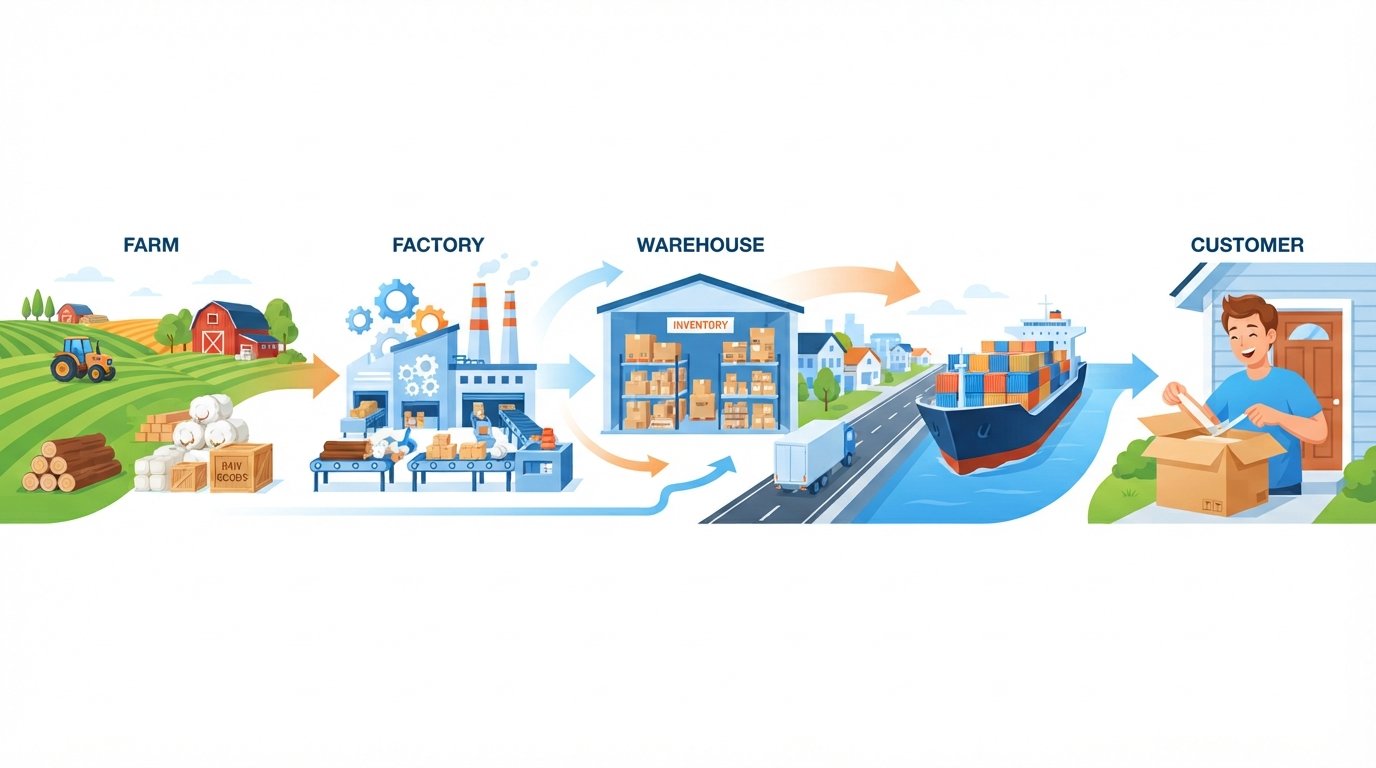
Have you ever had a pizza ordered? Purchased a new mobile phone? Gone into a local shop to buy a bottle of water? If you have then you’ve already been part of a supply chain! Have you ever thought about what actually happens behind the scenes to get the products to you? That’s where Supply Chain Management (SCM) comes in.
Having been in the supply chain industry for 8 years I’ve worked with suppliers, manufacturing units, warehouses, transporters and the delivery teams. I have regularly been asked by students, fresh graduates, new employees and friends,
What is Supply Chain Management?
For many it sounds like a rather complicated or technical term but once you actually understand how it all works from start to finish it can be absolutely straightforward.
This guide is going to explain what Supply Chain Management is in simple, plain English. It’s going to tell you what it is, the key components of it, the various types, some examples, the tools that are commonly used, the challenges and the opportunities for jobs in the field. It’s aimed at students, fresh graduates and anyone who’s just got an interest in the area. It’s going to help you get to grips with the fundamentals.
What is Supply Chain Management? (Simple Defination)
What is Supply Chain Management (SCM)? It’s the process of planning and controlling all the activities involved in sourcing of raw materials, making the product, storing it and getting it to the end customer.
It can be broken down into 3 simple steps,
Buy – Raw materials are purchased from suppliers.
Make – Raw materials are used to make finished products.
Deliver – Finished products are delivered to the customer/retailer.
The objective of Supply Chain Management is to get everything running smoothly. Products should be delivered on time, in the right place and at a reasonable price.
If the raw materials don’t get to the factory in time for it to use then production could come to a standstill which would in turn lead to delivery delays.
To help you with exams, interviews or to understand quickly,
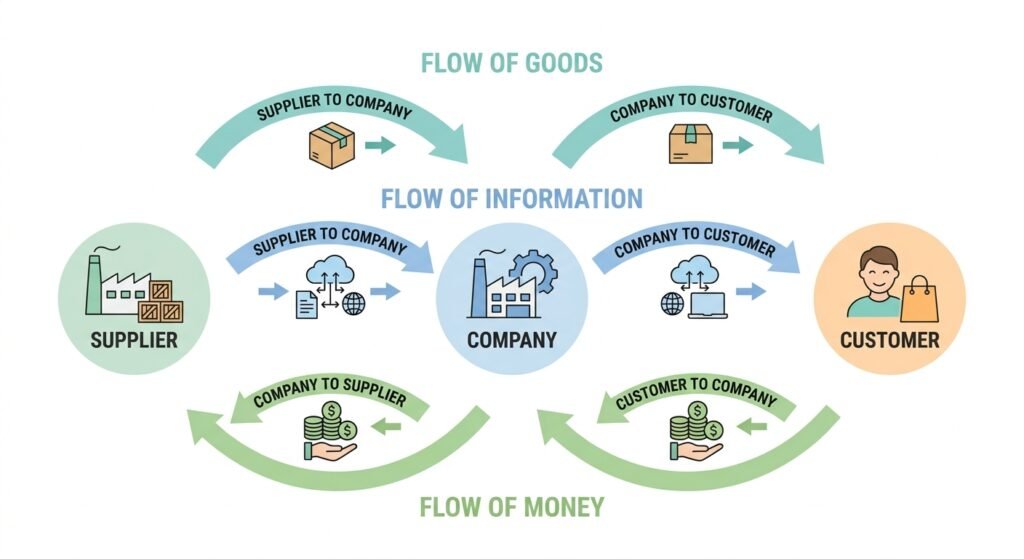
Supply Chain Management is the management of the flow of goods, information and money from the supplier to the end customer.
There are 3 main flows within any supply chain,
Goods – Raw materials, work in progress and finished goods being moved from one place to another.
Info: Purchase orders, customer demand, sales forecasts, stock levels and delivery updates are all shared between the parties.
Money – Payments are made between customers, businesses, suppliers etc.
A good supply chain will ensure that those 3 flows are all managed properly. It’s a case of saving money through reduced waste, avoiding delays and providing a better service to the customer by getting the goods,the information and the payments all flowing.
Why does Supply Chain Management matter?
It’s a critical function in any business.
Before we go any further on to what is supply chain management it’s important to understand why businesses need it.
From my time in the supply chain business I’ve seen this phenomenon: customers simply don’t think about the supply chain when it’s all working perfectly. They only become aware of it when something goes wrong. A product is out of stock on the shelf, an online order has arrived late, a parcel has arrived with damage to the package etc. There’s invariably a supply chain issue at the root of that.
But SCM is about so much more than just avoiding those problems. It’s a major contributor to the success of the business as a whole.
Here are five reasons why it matters:
- It Helps Reduce Costs
Proper planning will see the right quantity of materials bought at the right time which in turn will prevent excess inventory, will reduce storage costs and will avoid the need for expensive emergency purchases. Put simply it’s all about good supply chain management and controlling your costs.
- It Keeps Customers Satisfied
Customers want products available when they need them and their orders to be delivered on time and in good condition. An effective supply chain is key to meeting these expectations and in turn to building good long term customer relationships.
- It Reduces Waste
Poor storage, poor transport and bad inventory control can all lead to damage and waste. This is particularly pertinent in the food, pharmaceutical and other perishable goods industries. Better supply chain management will go a long way to reducing such losses.
- It Gives Businesses a Competitive Advantage
Imagine two companies selling the same product at a similar price point. One company is consistently on time with its deliveries and has its product in stock, the other is not. Most customers would go with the first of those two. That’s the value of an efficient supply chain.
- It Helps Businesses Handle Unexpected Situations
Supply chains are vulnerable to a whole host of unforeseen events; floods, strikes, fuel price increases, political instability and shortfalls in the availability of raw materials being just a few examples. A supply chain that is flexible and well planned is generally in a much better position to deal with such events and to keep going.
So when someone asks “What is supply chain management and why is it important?” you can say it’s the system that enables a business to control its costs, run its day to day business, deliver its product and keep the customer happy. The customer may not see it but it’s absolutely vital to the running of the business.
The 5 Key Parts of Supply Chain Management
Now that we’ve established why supply chain management is important, let’s look at how it actually operates.
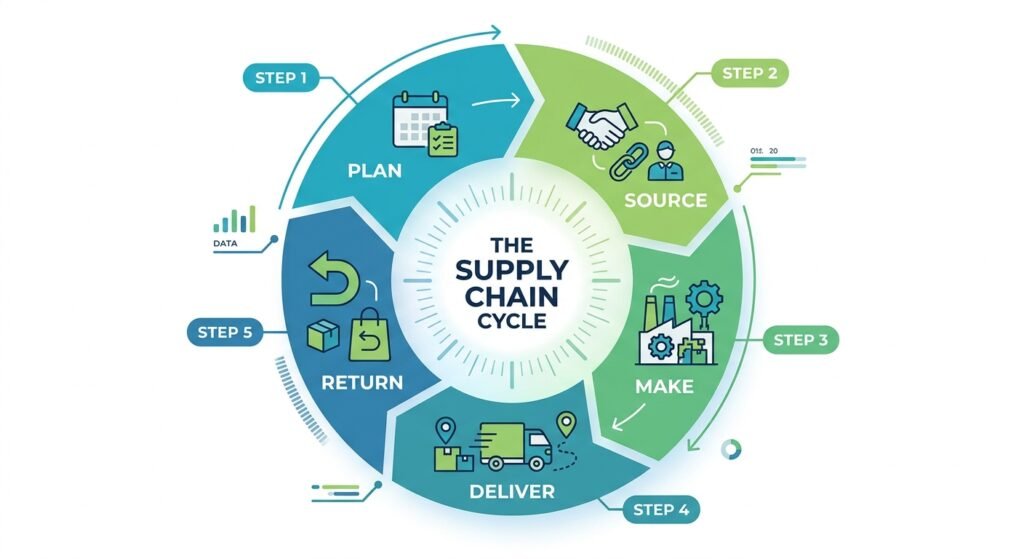
To get a proper understanding of what supply chain management is you need to know about its 5 major activities. These are generally described in the following stages: Plan, Source, Make, Deliver and Return.
1. Plan
Planning is where the supply chain process kicks off. Before you go out and buy your materials or indeed start to produce anything you need to have some idea of how much your customers are going to buy. That’s demand forecasting.
Based on these estimates the company will decide how much raw material to buy, how many products to make and what level of inventory to hold.
For instance an ice cream maker will know that demand goes up in the summer so they’ll be in a position to buy their raw materials and ramp up production prior to the summer season.
2. Source
Once the company has worked out what it needs the next stage is sourcing. That’s about identifying appropriate suppliers and then buying the raw materials, products and services that it needs.
It’s not just about price when you’re selecting a supplier. You’ll also look at product quality, lead time, terms of payment and the reliability of the supplier.
For instance a supplier who offer you a lower price may not necessarily be the best one if they’re consistently late with their deliveries. The delays can obviously stop production and end up costing you more in the long run.
3. Make
This is the stage at which the raw materials are turned into the finished product via manufacturing or production.
The primary objective is to produce the goods to the required quality, on time and at a reasonable cost. The company will also be monitoring machine performance, labour productivity, production efficiency and material waste.
For example in an edible oil manufacturer the process would be to take the crude or refined oil, do the quality testing, fill the bottles or tins, do the labelling and then get the product ready for dispatch.
4. Deliver
After production the finished products need to get to the customer and that’s where the delivery stage comes in.
It covers order processing, warehousing, inventory management, transportation and finally the delivery of the goods. The goods will of course pass through a variety of modes of transport depending on the business in question (trucks, trains, ships, aircraft, local delivery etc).
This stage is very much tied in with logistics (the storage and movement of goods from one place to another).
For instance, after the cooking oil has been manufactured it is then transported from the factory to the distributors, to the wholesalers, to the retailers and on to the consumer.
5. Return
Not every product gets to the customer in perfect condition and of course customers will occasionally just want to return an item. That’s why the return process is also a key element of supply chain management.
It covers damaged goods, incorrect deliveries, customer returns, refunds, repairs, recycling and where appropriate product disposal.
For instance if a customer got a damaged bottle of cooking oil the company would have to look into that, sort out a replacement and then work out what had gone wrong in the packaging or despatch process.
A well-run return process is the key to dealing with customer complaints and improving product quality.
When those five activities are all working together you’ve got the complete supply chain process: Plan, Source, Make, Deliver and Return. That’s the way to understand it really and it makes it so much easier to see how a product actually moves from the point of origin to the end customer.
Who are the players in a supply chain?
A supply chain is not one company. It’s a team of lots of different people and companies. When I explain what is supply chain management to new joiners, I always show them this list:
Suppliers: They provide the raw materials or the parts. Example: a cotton farmer.
Manufacturers: take the raw materials and turn them into a product. Example: a clothing factory.
Distributors and wholesalers: they buy in bulk and sell to the shops.
Retailers: they sell to the end customer. Example: a mall or an online store.
Transport companies: they move goods by road, rail, sea or air.
Customers are the final buyers. Everything in the chain is there to serve them.
Each player is dependent on the others. If the supplier is late the factory stops. If the factory stops the shop has nothing to sell. That’s why supply chain management is really a question of teamwork.
Types of Supply Chain Management
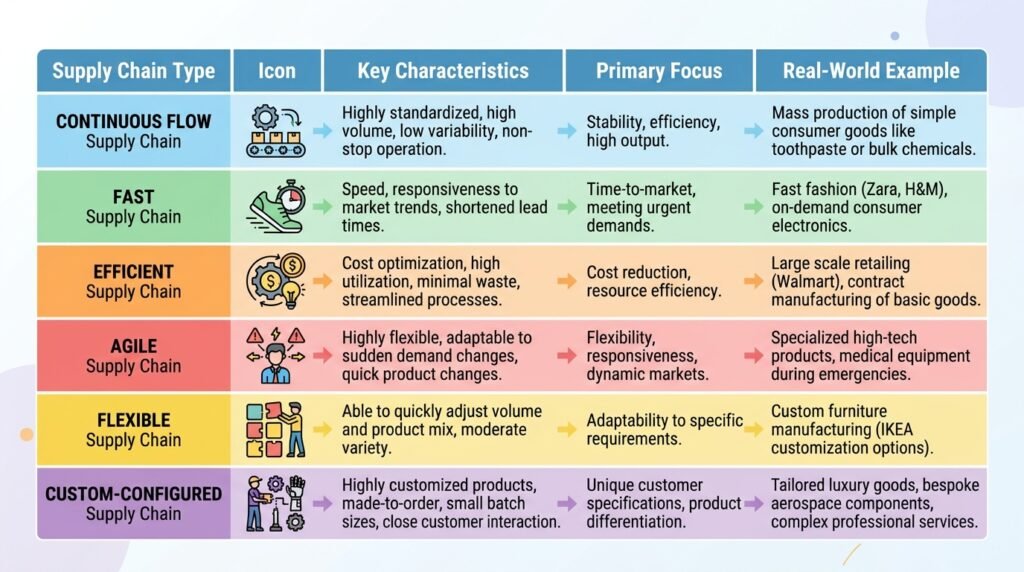
Not all supply chains are the same. A bakery and a car company are going to be very different in their operations. Here are the most common types of supply chain management that every beginner should be aware of.
- Continuous Flow Supply Chain
This is the type of operation that’s ideal for products that are in constant demand and don’t change. Think of things like rice, sugar and salt. The factory is just going and producing all the time, the product is flowing. It’s the simplest and cheapest model.
- Fast Supply Chain
This one is for the trendy products that sell quickly (fashion, gadgets etc). You’ve got to be able to produce small batches quickly and change designs all the time. Speed is the key factor here rather than low cost.
- Efficient Supply Chain
Here the objective is to keep the cost as low as possible. You’ve got the same product as a whole host of other companies out there, essentially (think basic groceries) and you’re going for high volume, low waste.
- Agile Supply Chain
An agile supply chain can react quickly when demand changes. It’s particularly useful when demand is difficult to forecast (e.g. for special order products or seasonal items). The system is kept flexible so it can respond quickly.
- Flexible Supply Chain
This one is ideal for products which have seasonal peaks (think umbrellas in the wet season, heaters in the winter etc) as you can ramp up or down production as required.
- Custom-Configured Supply Chain
This is a hybrid approach. A company will build part of the product in the normal way and then customise the final product for each individual customer. PC makers are a good example of this.
Other Ways to Look at Types
Experts also divide supply chains in other ways:
Local versus global supply chains: a local chain stays within one country or one region. A global chain spans many borders.
Forward versus reverse supply chains: a forward chain takes the product to the customer. A reverse chain takes the product back from the customer for return, repair or recycling.
Lean versus green supply chains: a lean chain cuts waste. A green chain looks after the environment.
If you go any deeper into what supply chain management actually is you’ll see that companies will often have a mix of several types depending on the product.
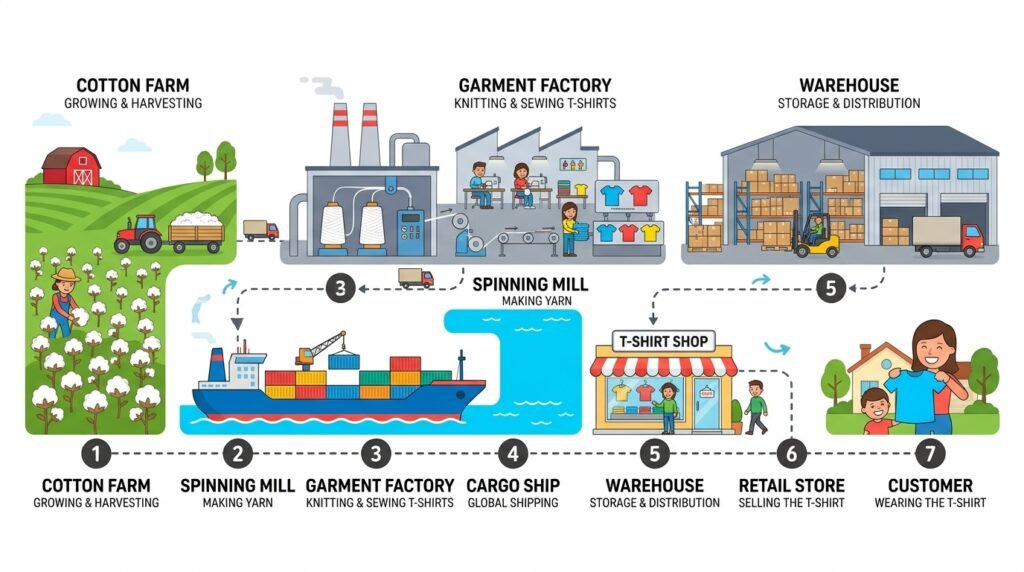
A Real-Life Example: How a T-Shirt Reaches You
Theory is all well and good but an example makes it all so much clearer. Let me show you what supply chain management actually is by taking one simple cotton T-shirt as an example.
Step 1: The farm. A farmer grows cotton. That’s the first in the chain.
Step 2: The spinning mill. The cotton is cleaned and spun into thread. The mill buys cotton from a number of farms and has to work out how much it needs each month.
Step 3: The fabric and garment factory. The thread is woven into fabric, the fabric is cut, stitched, dyed and packed as T-shirts. There are quality checks at this stage.
Step 4: Transport. The T-shirts are packed into cartons and loaded onto a truck. The truck takes them to a port where they are loaded onto a ship which will carry the cartons to the destination country. All the necessary customs paperwork is completed.
Step 5: The warehouse. The cartons get to a distribution centre where they are scanned, sorted and stored. The computer system tells the team how many t-shirts are in each size.
Step 6: The store or website. The retailer sells the T-shirt in a shop or online. If you order online then a delivery rider will bring it to your door.
Step 7: The return. If it’s the wrong size you send it back. They check it, clean it and put it back on sale.
Now think about what can go wrong. A storm could put the cotton harvest off. A port strike could hold the ship. A computer error could show the wrong stock. The supply chain managers are watching every step of the way and fixing the problems before the customer even notices. That’s the real answer to what supply chain management is: it’s problem solving across the chain.
A Quick Modern Example: Online Shopping
When you order something from a big online store, supply chain management works in the background:
- The system will check the nearest warehouse for your item.
- The warehouse team pick and pack it.
- A courier picks it up.
- You get tracking updates on your phone.
- It gets to you at your door, usually within one or two days.
All of that is based on forecasting, data and careful planning. That’s supply chain management in a nutshell, day in day out.
 Supply Chain Management vs. Logistics: What Is the Difference?
Newbies confuse these two concepts very often. At least, I did at my first year. So here is the answer to this question:
Logistics is the single link in the chain. It is responsible for the transportation and storage of goods.
Supply chain management is the whole process. It involves logistics, planning, procurement, manufacturing, and returning.
Therefore, when people ask about the differences between what is supply chain management and logistics, you can reply that logistics is the single player, while supply chain management is the whole team and coach.
Technologies Used in Supply Chain Management
Nowadays, no one can run a supply chain with pieces of paper and phone calls. Modern technologies have transformed this area. The following are the key tools which you should know:
- ERP software. ERP means Enterprise Resource Planning. It integrates the areas of finance, procurement, manufacturing, and sales.
- Warehouse Management System (WMS). This software manages inventory, locations, and orders inside the warehouse.
- Transport Management System (TMS). It helps to plan routes, choose carriers, and track shipments.
- Barcode and RFID. These labels allow to scan the items quickly without errors.
- GPS
Frequently Asked Questions (FAQ)
What is supply chain management in simple words?
In simple words, supply chain management is the work of getting a product from the raw material stage to the customer’s hands in the best way. It covers buying, making, storing, moving, and delivering.
What are the main goals of supply chain management?
The main goals are to lower costs, deliver on time, keep good quality, reduce waste, and make customers happy.
Is supply chain management a good career?
Yes. Almost every business needs supply chain professionals. The field offers steady jobs, room to grow, and chances to work in many industries and countries.
What is the difference between a supply chain and supply chain management?
A supply chain is the network of people, companies, and steps that create and deliver a product. Supply chain management is the work of planning and controlling that network.
Do I need a degree to start?
A degree in business, logistics, or supply chain helps, but it is not the only path. Many people start in warehouses, purchasing, or customer service and grow from there. Certificates and practical skills also count.
Final Thoughts
So, what is supply chain management? It is the hidden system that connects farms, factories, warehouses, trucks, shops, and homes. It makes sure the things we need are available when we need them. When it works well, nobody notices. When it fails, everybody feels it.
I hope this beginner’s guide made what is supply chain management clear and easy for you. Start with the five stages, study the types, watch real examples around you, and build your skills step by step. Whether you are a student, a job seeker, or a business owner, understanding supply chain management will help you see the world of products in a new way.
If you have questions, leave a comment below, and I will be happy to help.